Introduction
Customer expectations have changed dramatically in the digital era. Today’s customers demand instant responses, personalized experiences, and 24/7 support across multiple channels. Traditional customer service teams often struggle to keep up with rising workloads, repetitive inquiries, and operational costs. This is where AI agents for customer service are transforming the modern business landscape.
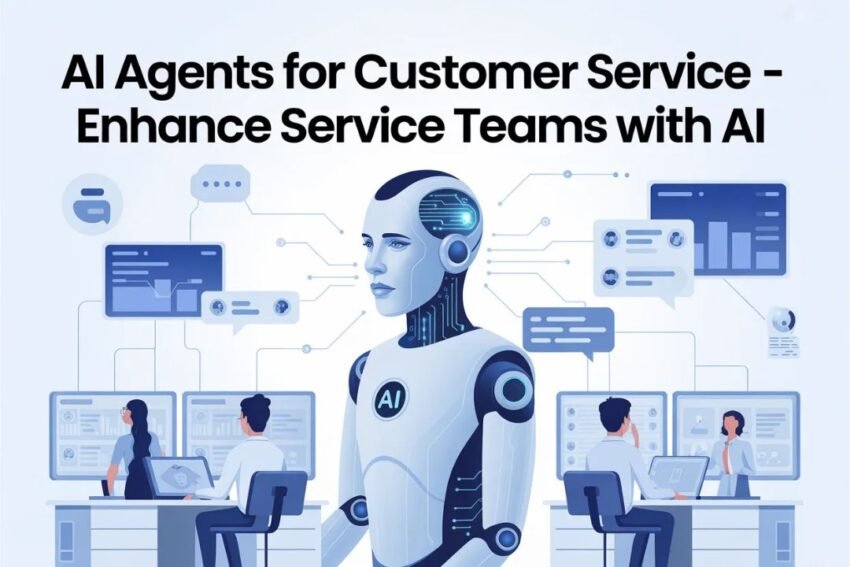
Artificial Intelligence (AI) is no longer a futuristic concept — it has become an essential tool for companies aiming to deliver faster, smarter, and more efficient support. AI-powered agents can automate conversations, assist human representatives, analyze customer behavior, and significantly improve service quality.
In this comprehensive guide, we will explore how AI agents enhance service teams, their benefits, real-world applications, implementation strategies, challenges, and future trends.
What Are AI Agents for Customer Service?
AI agents are intelligent software systems powered by technologies such as:
- Machine Learning (ML)
- Natural Language Processing (NLP)
- Generative AI
- Predictive analytics
- Automation workflows
These agents interact with customers through chat, voice, email, or messaging platforms, simulating human-like conversations while continuously learning from interactions.
Unlike traditional chatbots that follow scripted responses, modern AI agents understand context, sentiment, and intent, enabling them to deliver more natural and personalized support.
Key Capabilities of AI Customer Service Agents
- Understand customer queries in natural language
- Provide instant automated responses
- Route complex issues to human agents
- Analyze customer sentiment
- Learn from past conversations
- Offer personalized recommendations
Why Businesses Are Adopting AI Agents
Customer service departments face several major challenges:
- High support ticket volumes
- Long response times
- Agent burnout
- Rising operational costs
- Inconsistent customer experiences
AI agents directly address these issues.
Growing Demand for Automation
Studies show that customers prefer quick resolutions over waiting for human representatives. Businesses implementing AI solutions experience:
- Faster response times
- Improved customer satisfaction
- Reduced support costs
- Higher agent productivity
AI does not replace human teams — it enhances them.
How AI Agents Enhance Service Teams
1. 24/7 Customer Support
Human agents cannot work continuously, but AI agents operate around the clock. Customers receive immediate assistance regardless of time zones or holidays.
This ensures:
- No missed inquiries
- Increased customer trust
- Global service availability
2. Handling Repetitive Queries Automatically
Up to 70% of customer questions are repetitive, such as:
- Order status
- Password resets
- Account updates
- Product information
AI agents automate these routine tasks, freeing human agents to focus on complex cases.
3. Faster Response Times
AI agents respond instantly, reducing waiting queues and improving first-response metrics — a key ranking factor for customer satisfaction.
4. Intelligent Ticket Routing
AI analyzes customer intent and automatically assigns tickets to the most suitable department or specialist, reducing resolution time.
5. Agent Assistance (AI Copilot)
AI doesn’t just help customers; it also supports employees by:
- Suggesting replies
- Providing knowledge base articles
- Summarizing conversations
- Offering next-best actions
This dramatically improves agent efficiency.
Types of AI Agents Used in Customer Service
Conversational AI Chatbots
Handle text-based interactions on websites and apps.
Voice AI Assistants
Automate phone support using speech recognition.
Virtual Customer Assistants
Provide personalized experiences using customer data.
AI Email Responders
Automatically draft or send replies to common inquiries.
Predictive Support Agents
Anticipate problems before customers contact support.
Benefits of AI Agents for Businesses
Improved Customer Satisfaction (CSAT)
Instant responses and personalized interactions lead to happier customers.
Reduced Operational Costs
Companies save money by automating large volumes of inquiries without expanding teams.
Scalability
AI agents handle thousands of conversations simultaneously without performance issues.
Consistent Service Quality
Unlike humans, AI agents deliver standardized and accurate responses every time.
Data-Driven Insights
AI analyzes conversations to identify:
- Customer pain points
- Product issues
- Service trends
- Buying behavior
Benefits for Customer Service Teams
AI agents are often misunderstood as job replacements. In reality, they empower teams.
Reduced Workload
Agents handle fewer repetitive tasks, allowing them to focus on meaningful interactions.
Less Burnout
Automation reduces stress caused by high ticket volumes.
Better Decision Making
AI provides real-time insights and recommendations.
Faster Training
New agents learn faster with AI-powered guidance tools.
Real-World Use Cases of AI Customer Service Agents
E-Commerce
AI agents assist customers with:
- Order tracking
- Returns processing
- Product recommendations
Result: Higher conversions and fewer abandoned carts.
Banking & Finance
AI helps customers check balances, report fraud, and manage accounts securely.
Healthcare
AI agents schedule appointments, answer FAQs, and guide patients through processes.
SaaS Companies
AI handles onboarding questions and technical troubleshooting.
Telecommunications
AI resolves billing queries and service interruptions quickly.
Key Technologies Behind AI Agents
Natural Language Processing (NLP)
Allows AI to understand human language, slang, and context.
Machine Learning
Improves accuracy over time through data analysis.
Sentiment Analysis
Detects customer emotions and adjusts responses accordingly.
Generative AI
Creates human-like replies instead of scripted answers.
How to Implement AI Agents Successfully
Step 1: Identify Support Gaps
Analyze customer inquiries and determine repetitive tasks suitable for automation.
Step 2: Choose the Right Platform
Look for AI tools offering:
- Omnichannel support
- CRM integration
- Analytics dashboards
- Custom training capabilities
Step 3: Train the AI Model
Use historical conversations and FAQs to teach the AI system.
Step 4: Start with Hybrid Support
Combine AI automation with human oversight.
Step 5: Monitor and Optimize
Continuously improve performance using analytics.
Best Practices for Using AI in Customer Service
- Maintain human escalation options
- Keep conversations natural and transparent
- Regularly update knowledge bases
- Monitor AI performance metrics
- Protect customer data and privacy
Common Challenges and Solutions
Challenge: Lack of Personalization
Solution: Integrate CRM data for contextual responses.
Challenge: Customer Resistance
Solution: Clearly inform users when AI is assisting them.
Challenge: Training Complexity
Solution: Start small and expand gradually.
Challenge: Data Security Concerns
Solution: Implement strong encryption and compliance policies.
AI Agents vs Human Agents: Collaboration, Not Competition
| Feature | AI Agents | Human Agents |
|---|---|---|
| Availability | 24/7 | Limited |
| Speed | Instant | Moderate |
| Empathy | Limited | High |
| Complex Problem Solving | Moderate | Excellent |
| Scalability | Unlimited | Limited |
The most effective customer service strategy combines both.
Future Trends of AI Customer Service Agents
Hyper-Personalization
AI will tailor responses using behavioral and historical data.
Emotionally Intelligent AI
Future systems will better understand tone and emotion.
Voice-First Customer Support
Voice AI assistants will dominate service channels.
Proactive Support
AI will solve issues before customers notice them.
Autonomous Service Workflows
AI agents will complete entire service processes independently.
SEO Advantages of Using AI in Customer Service
Businesses using AI customer service systems benefit from indirect SEO improvements:
- Faster website interaction
- Reduced bounce rates
- Improved user experience
- Higher engagement metrics
These factors contribute to better Google rankings.
Measuring Success of AI Agents
Track these KPIs:
- First Response Time (FRT)
- Customer Satisfaction Score (CSAT)
- Resolution Time
- Automation Rate
- Cost per Ticket
- Customer Retention Rate
Industries That Benefit Most from AI Agents
- E-commerce
- SaaS platforms
- Healthcare
- Finance
- Travel & hospitality
- Education platforms
- Telecommunications
The Future of Service Teams with AI
AI agents will become digital teammates rather than tools. Service teams will shift from reactive support to strategic customer experience management.
Human agents will focus on:
- Relationship building
- Complex negotiations
- Emotional interactions
- High-value customers
AI will manage operational efficiency behind the scenes.
Conclusion
AI agents for customer service are redefining how businesses interact with customers. By automating repetitive tasks, improving response speed, and supporting human teams, AI enhances both efficiency and customer satisfaction.
Organizations that adopt AI-driven support today gain a competitive advantage through scalable operations, better customer experiences, and smarter decision-making.
The future of customer service is not human versus AI — it is human plus AI working together to deliver exceptional service.
Businesses that embrace this transformation now will lead the next generation of customer experience innovation.
FAQs (SEO Optimized)
1. What are AI agents in customer service?
AI agents are intelligent systems that automate customer interactions using artificial intelligence technologies like NLP and machine learning.
2. Do AI agents replace human customer service representatives?
No. They assist human agents by handling repetitive tasks and improving efficiency.
3. Are AI customer service agents expensive?
Initial setup costs exist, but long-term savings from automation are significant.
4. Can AI agents understand customer emotions?
Advanced AI uses sentiment analysis to detect emotions and adjust responses.
5. Which businesses benefit most from AI customer service?
E-commerce, SaaS, finance, healthcare, and telecom industries benefit greatly.